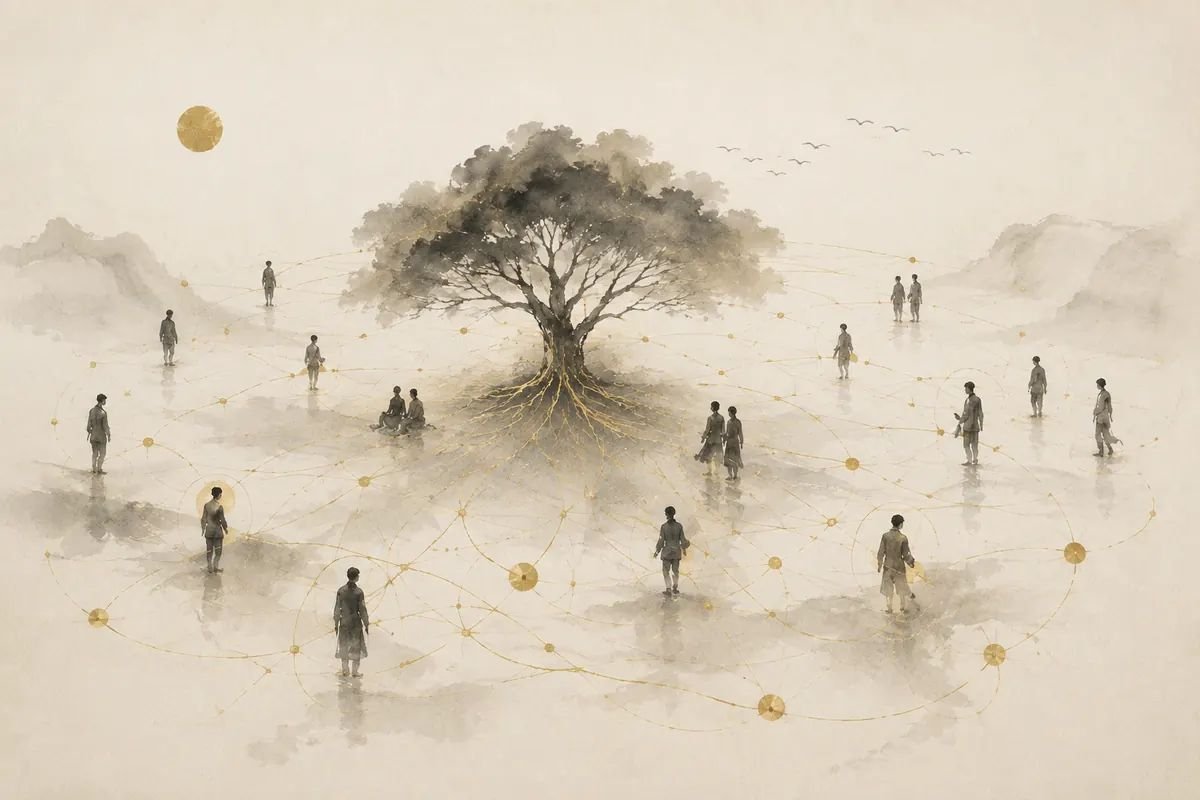
Humans are living systems, adaptive, diverse, and self-organizing. Yet the digital systems that now shape how billions of humans interact are more like a centralized, optimized, and controlled machine. That mismatch is structural.
01The Structural Mismatch
The problems we associate with modern social media, polarization, anxiety, performative behavior, erosion of trust, and brittleness in civil society, are not only a result of poor moderation, oligarch ego or flawed algorithms. They are the predictable outcome of forcing a living system into a non-living synthetic architecture.
Social media sits at the intersection of two realities: a living human network and a digital framework in which we interact with one another. But the digital layer was not designed to behave like a living system.
Because digital experience shapes lived experience, the damage loops back. A digital system that is not structured as a living system causes humans to behave in ways that are less adaptive, less diverse, and less healthy. Over time, we become disconnected from the very conditions that sustain us as part of a living system.
This paper explores why that matters, and what must replace it.
02The Core Problem
Humans exist as part of a vast living system. Biological, ecological, and social systems all share common characteristics: they are adaptive, diverse, self-organizing, and continuously evolving.
When humans began connecting digitally at scale, we effectively created an extension of that living system, a global human interaction network operating far faster and at far greater reach than anything biology evolved for.
But instead of building that digital layer according to the principles of living systems, we built it as a centralized machine. Modern social media platforms operate as closed environments governed by centralized incentives and control. Visibility, incentives, amplification, and behavior are shaped by algorithms and policies designed primarily to maximize engagement and revenue.
The result is a structural mismatch. A living system is being forced to operate inside a synthetic container. When that happens, the system becomes brittle.
Diversity narrows.
Feedback loops collapse.
Autonomy disappears.
Dependency increases.
The harm we see in social media today is not operational. It is architectural.
03The Laws of Living Systems
To understand why this matters, we must first understand how living systems work. Across biology, ecology, and systems science, several common principles consistently appear wherever life organizes itself.
Living Systems Are Dynamic and Open
Living systems are never static. They exist far from equilibrium and continuously adjust in response to flows of energy and matter. In digital social systems, these flows appear primarily through information and interaction.
Physicist Ilya Prigogine, whose work on thermodynamics earned the Nobel Prize in Chemistry in 1977, showed that complex systems far from equilibrium can spontaneously organize into new structures. These “dissipative structures” maintain their order not by reaching a stable resting state, but by continuously exchanging energy with their environment.
Living systems also maintain homeostasis, dynamic internal regulation that allows the system to remain stable even as conditions constantly change. This balance does not come from stasis, but from continuous adjustment through feedback loops across the system. Homeostasis allows living systems to maintain internal stability without requiring the entire system to settle into equilibrium.
Life is not a state of equilibrium, but a continuous process of dynamic regulation.
Living Systems Require Diversity
Diversity is not cosmetic. It is structural. Functional, behavioral, relational, and demographic diversity allows living systems to remain adaptive and resilient.
When diversity collapses, roles collapse. Feedback loops narrow. Interaction density thins. What once evolved becomes brittle.
Ecology demonstrates this clearly. Biodiversity correlates strongly with resilience. Monocultures may appear orderly, but they are fragile. Remove one element, introduce one disruption, and the system can collapse.
Look at Mars. It is not chaos that signals lifelessness.
It is uniformity.
Living Systems Adapt Through Distributed Feedback and interdependence
“The web of life is a network of relationships in which the existence of organism depends on the existence of others.”Fritjop Capra
This also means that living systems do not rely on centralized control. They adapt through distributed interaction. Imbalances are detected and corrected through feedback loops across the system rather than through a central command authority.
Living Systems Regenerate Themselves
“A living system is defined by the network of processes that produce the components that in turn regenerate the network that produces them.”Humberto Maturana and Francisco Varela
They created the term autopoietic, self-producing networks capable of repairing and regenerating themselves.
Autopoiesis also requires autonomy. Each participant in the system must be able to act, respond, and adapt.
Life does not optimize.
Life adapts.
04Why Modern Social Media Breaks These Laws
Modern social media platforms violate nearly every principle that allows living systems to remain healthy.
| Living Systems | Modern social media |
|---|---|
| Open | Closed walled gardens |
| Diverse | Algorithmically narrowed exposure |
| Distributed feedback | Centralized moderation and policy |
| Autonomous actors | Platform-controlled identity and visibility |
| Self-organizing | Algorithmically steered outcomes |
Rather than enabling natural interaction patterns to emerge, social media platforms dictate incentives, visibility, and amplification through centralized algorithms. Participants do not own their identity, their content, or their relationships. Platforms control them.
The system does not self-correct.
It is managed.
Closed Systems Instead of Open Networks
Modern social media networks are structurally closed systems. They operate as walled gardens. When someone joins a platform, they are siloed inside that environment and separated from others. Identity, relationships, and content cannot move freely across networks.
Each platform represents only a partial expression of the broader digital ecosystem: Instagram for visual content, YouTube for long-form video, LinkedIn for professional identity, Pinterest for visual discovery. Each reflects a different type of human interaction. But because these networks are sealed off from one another, the diversity and resilience of the broader digital ecosystem are weakened.
In the physical world, our identity moves with us. If I meet someone at Starbucks, share a song we enjoy, and later run into them at Whole Foods, I do not need to introduce myself again or repeat the conversation. My identity and relationships persist across contexts. Digital interaction should work the same way.
Algorithmically Narrowed Diversity
Living systems rely on diversity to remain adaptive. Modern platforms move in the opposite direction.
Algorithmic systems sort participants into clusters designed to maximize engagement and predictability. Rather than expanding exposure to different perspectives and communities, these systems narrow interaction into engagement-optimized bubbles.
These clusters are not natural social formations. They are artificial groupings created by optimization functions designed to drive measurable outcomes. Living systems do not impose such outcomes. They allow communities and relationships to form organically through voluntary interaction.
Centralized Control Instead of Distributed Feedback
Social media networks are centralized in both control and policy. A small number of people, in some cases a single individual, govern visibility, incentives, and behavioral norms for billions of participants.
Even the term “user,” commonly used to describe people on these platforms, subtly decouples the idea that there is a human being on the other side and a broader system of humans interacting with one another.
In living systems, imbalance triggers distributed adjustment across the network. In modern platforms, correction is managerial. Moderation policies, enforcement waves, and algorithm adjustments substitute for organic regulation, and these interventions remain subordinate to the platform’s economic incentives.
The system does not heal.
It is managed.
Platform-Controlled Identity Instead of Autonomous Actors
In living systems, adaptation depends on autonomy. Each participant must be able to act, respond, and adjust.
On modern social platforms, participants do not control their digital identity, their content, or their relationships. Platform owners do. While individuals contribute creativity, conversation, and community, the platform ultimately determines how that contribution moves through the system. As we mentioned earlier, living systems are Autopoetic (self-correcting), we need our social networks to be as well.
If individuals cannot control their participation, their relationships, or the movement of their contributions, they cannot adapt. And if individuals cannot adapt, the system itself cannot adapt. The feedback loops that allow living systems to regulate themselves are therefore broken.
Algorithmically Steered Systems Instead of Self-Organizing Networks
Success within modern social media systems is measured primarily through revenue generated by engagement and platform utilization. Participants are not treated as members of a living network or even as customers. They are treated as economic inputs, digital commodities whose attention, behavior, and relationships can be converted into revenue.
Rules and algorithms are designed to dictate outcomes, maximizing engagement, maximizing time on platform, and maximizing revenue, rather than allowing interaction patterns to emerge organically across the network.
Furthermore, the economic model itself is opaque. The rules that determine who makes money, and how much, are built into systems optimized for engagement and scale. Participants cannot see or influence those rules. It is not an open marketplace where people freely exchange value. It is a system designed by, and optimized for, the central authority of the platform: its founders and shareholders.
Again, completely orthogonal to a living system. The result is a system that appears to be a network, but behaves structurally as a centralized machine layered on top of a living society.
05The Consequence
We are seeing rampant erosion of civil discourse, polarization, performative behavior, and rising anxiety, which are often attributed to algorithms or moderation decisions.
Even those with the best of intentions starting out on the platform eventually yield to the algorithm and must change and adapt their behavior to deliver more content in a way that it’s consumed more.
Science has shown that this has affected our neurotransmitters, literally rewiring the human brain to the dopamine effect.
Worse still, this is eroding the fabric of civil society and the free world as it’s been weaponized for geopolitical purposes, wealth creation, and societal manipulation.
Efforts to legislate, build new platforms, and create interoperability with existing ones are all being initiated to solve this issue. The deeper problem is architectural.
The harm is not accidental.
It is structural.
06Why Reform Cannot Fix It
Most attempts to fix social media focus on improving the existing platform model. These efforts typically involve algorithm adjustments, moderation policies, regulatory frameworks, or new civic platform designs.
But these approaches attempt to repair symptoms while leaving the underlying architecture unchanged.
Complex systems cannot be controlled at scale through centralized rulemaking. The complexity of human interaction will always outpace policy.
Trying to fix social media through regulation or algorithm tuning is like continually adding complexity to the tax code. Each adjustment attempts to correct a problem but ultimately produces a more brittle and unwieldy system.
The problem is not optimization.
The problem is architecture.
07Building an Enabling Ecology
If we want different outcomes, we must build a different architecture.
Instead of centralized platforms, a healthy digital social world must be built as an interoperating network of networks. An enabling ecology rather than a single platform.
Networks of many sizes, cultures, interests, and communities can exist simultaneously. Some may be small and local. Others may be large and global. The key is that none operate as closed containers.
The architecture is built on several foundational principles.
Human Verification
The base layer of a healthy social network must be human. Participants must be verified as human beings rather than bots or synthetic amplification systems.
Interoperability
Identity should not reset when a person moves between digital environments. Just as in the physical world, individuals remain the same person across multiple contexts. Digital identity, relationships, and content should travel with the individual, under their control.
Interoperability is central to diversity and health of the social media ecosystem. It is the backbone of decentralization.
Sovereign Ownership
Participants must own their identity, their content, and their relationships. If someone leaves a network, they do not lose their digital life. They take it with them.
Transparent Monetization
Markets within the network should operate openly rather than through hidden engagement-maximizing algorithms. Participants choose the content and advertising they see, who they want to hear from, and how they want to monetize their own networks. Influencers, the engine that connects brands and communities, should have the freedom to monetize their audiences as they see fit.
In a true market, choice is the cornerstone. Revenue still exists, networks need it to survive, but it should not hijack the behavior of the entire system. Instead of a centrally optimized revenue machine, the network becomes a place where value exchange happens openly among participants.
Monetization is one of the three energy transfers in the system. After interaction and engagement, it is the economic energy that sustains the network. But like any healthy system, it must remain in balance with the network rather than becoming its dominant force.
Distributed Network Creation
Distributed network creation means social networks should be as easy to create as websites. You no longer need to build a global platform to create a viable community. Individuals, organizations, and groups can stand up their own networks, govern them, shape their culture, and define their norms.
Just as anyone can create a website today, anyone should be able to stand up a network and connect it to others through an open digital backbone.
Social networks should form around communities rather than forcing communities into centralized platforms.
08The Emergent Trust Layer
Within this architecture, something new becomes possible, an element that becomes the connective force across the network. Just as living systems operate through natural flows of energy, a digital network can create a proxy for that dynamic.
Instead of centralized ranking systems or social credit scores, trust emerges through behavior. This behavior becomes the regulatory, self-governing mechanism of the network, an autopoietic switch, so to speak.
As individuals participate across networks, patterns begin to appear.
- Do they spark insight?
- Do they ground conversations in truth?
- Do they uplift others?
- Do they show up authentically?
- Do they model humanity and civil engagement?
- Do they reflect gratitude and awareness over time?
Over time, these patterns form a digital fingerprint, a reflection of behavior across interactions.
Not a score imposed from above.
An emergent signal.
That fingerprint moves with the individual, by their choice, across networks. It becomes part of how trust forms. This is how we operate in the real world: our human presence travels with us.
This is how accountability emerges without central command.
You are not being managed.
You are participating.
Your behavior shapes your reputation across environments.
09A Living Digital Ecosystem
Within this architecture, many types of networks can exist:
- Professional communities
- Local networks
- Art and creative networks
- Political debate spaces
- Humor and entertainment communities
Each network defines its own culture and governance. Individuals within those networks define their own identity. No network or person is isolated, unless they choose to be. Identity and interaction can move between networks through the shared digital backbone.
Diversity expands rather than collapses.
Power distributes rather than concentrates.
Synthetic amplification becomes far more difficult in a system built around human participation rather than centralized algorithmic amplification.
Instead of forcing billions of people into a single container optimized for engagement, we enable a living ecosystem of interconnected digital communities.
10Conclusion
Modern social media did not fail because people are flawed or speech is difficult. It failed because we attempted to force a living human system into a centralized machine.
Living systems require diversity, autonomy, distributed feedback, and the ability to regenerate. Centralized platforms suppress those properties. The result is instability.
A healthier digital world will not come from improving the existing platform model. It will come from building an architecture that reflects how living systems work.
Because the digital environments we build shape how humans interact, think, and organize themselves.
The science exists.
The technology exists.
The need is clear.
A living digital social system is not only possible.
It is necessary.