
A lot is being written about AI from financial, technical, and AI-for-society perspectives. Economists study capital. Technologists study compute. Labor researchers study jobs. Bankers study credit risk. Each understands an important slice. What remains largely missing is a simple view of how those slices interact and what the whole system is becoming.
“The nature of the whole is always different from the mere sum of its parts.”Fritjof Capra, The Web of Life
Just as social media networks are out of balance, we are seeing another system that has moved badly out of balance. We cannot have a useful conversation about what comes next until more of us can see what is happening now.
We are seeing, in this moment, a unique force shaping the world and pulling it well out of balance. This paper does not argue how we got here, but points to the fact that we are here and need to act.
01One layer became the whole field
The largest force is the power of global technology corporations: their sheer size and their capacity to drive the narrative and, therefore, the capital markets. Nested inside that is the rate of technological change and the speed at which it is outrunning our ability to govern ourselves.
Modern technology corporations have built and deployed technology so quickly that governments’ ability to understand and act in time is being left in the dust. Combine that with an aging Congress in the United States, and this is what we are seeing:
We have just made the largest investment in human history in a single layer of a technology called AI that has been evolving for decades. The Apollo program, the Interstate Highway System, the Marshall Plan, and not even most war have come close. Somewhere between five and eight trillion dollars is being poured into AI and the data centers that power it.
AI is one of the most transformative technologies ever created and can be an extraordinary force for good. Large language models are useful. Centralized data centers are necessary. That is not the question. The question is whether they are the only answer, and whether concentrating five to eight trillion dollars behind that one path, before its economics, governance, and consequences are understood, makes any sense.
So far, the answer is troubling. What began as a technological revolution has become a capital land rush driven as much by stock-market expectations as by long-term economics. It is reversing years of climate progress and creating ecological, social, financial, and geopolitical problems faster than governments can respond. Basic questions like whether the revenue covers the cost, whether the business model works, what the path to profitability is, and what the broader return to society is have been pushed aside.
AI also differs from previous waves of automation. The loom replaced the weaver’s hands. The typewriter replaced the stenographer’s mechanical skill. Both left judgment, reasoning, and creativity as the next frontier for work. AI directly challenges that cognitive fallback. There is no obvious protected category waiting behind it.
Now experts are sounding the alarm. The Bank for International Settlements has identified an AI crash as a major threat to global financial stability. JPMorgan, Bain, Sequoia, and even U.S. Treasury analysts have raised serious concerns about the economics and systemic risk behind the current investment cycle.
Artificial intelligence is not new. The field was named at the Dartmouth Workshop in 1956, but its roots stretch through decades of mathematics, computer science, cybernetics, neural networks, machine learning, expert systems, computer vision, robotics, and natural-language processing.
AI is the broad discipline of building machines that perform tasks associated with human intelligence. Machine learning is one approach within AI; deep learning is a subset built on large neural networks; generative AI is one application that creates text, images, software, audio, and video.
The distinction matters because AI is far larger than the frontier language models dominating today’s headlines. It already powers medical diagnostics, fraud detection, industrial automation, logistics, scientific discovery, robotics, manufacturing, weather forecasting, and thousands of specialized applications.
A defender of this concentration might argue that frontier models will become the intelligence layer beneath everything else, making investment in them equivalent to investing in AI itself. Technically, that is not true. Many AI systems cannot depend entirely on a remote frontier model or a centralized data center. Robotics, factories, hospitals, telecom networks, vehicles, security systems, and other real-time environments often require inference close to where data is created because latency, reliability, privacy, sovereignty, power, and connectivity determine whether the application works at all. These systems may use frontier models, smaller specialized models, traditional machine learning, embedded intelligence, or combinations of all four, running across heterogeneous processors and distributed infrastructure. The future of AI is therefore not one model operating from one centralized architecture. It is a layered and distributed computing environment in which different forms of intelligence run where they are technically and economically appropriate.
Yet most of the estimated $5–8 trillion now being committed is concentrated in one architectural layer: the centralized hyperscale infrastructure needed to train and operate the largest frontier models. As Figure 1 shows, the money is flowing into data centers, GPUs, servers, networking, memory, power, cooling, land, and the financing required to build them. The rest of the AI field receives only a fraction of that investment.
We are not investing five to eight trillion dollars in AI. We are investing it in one architecture for delivering AI: centralized hyperscale computing built around frontier foundation models.
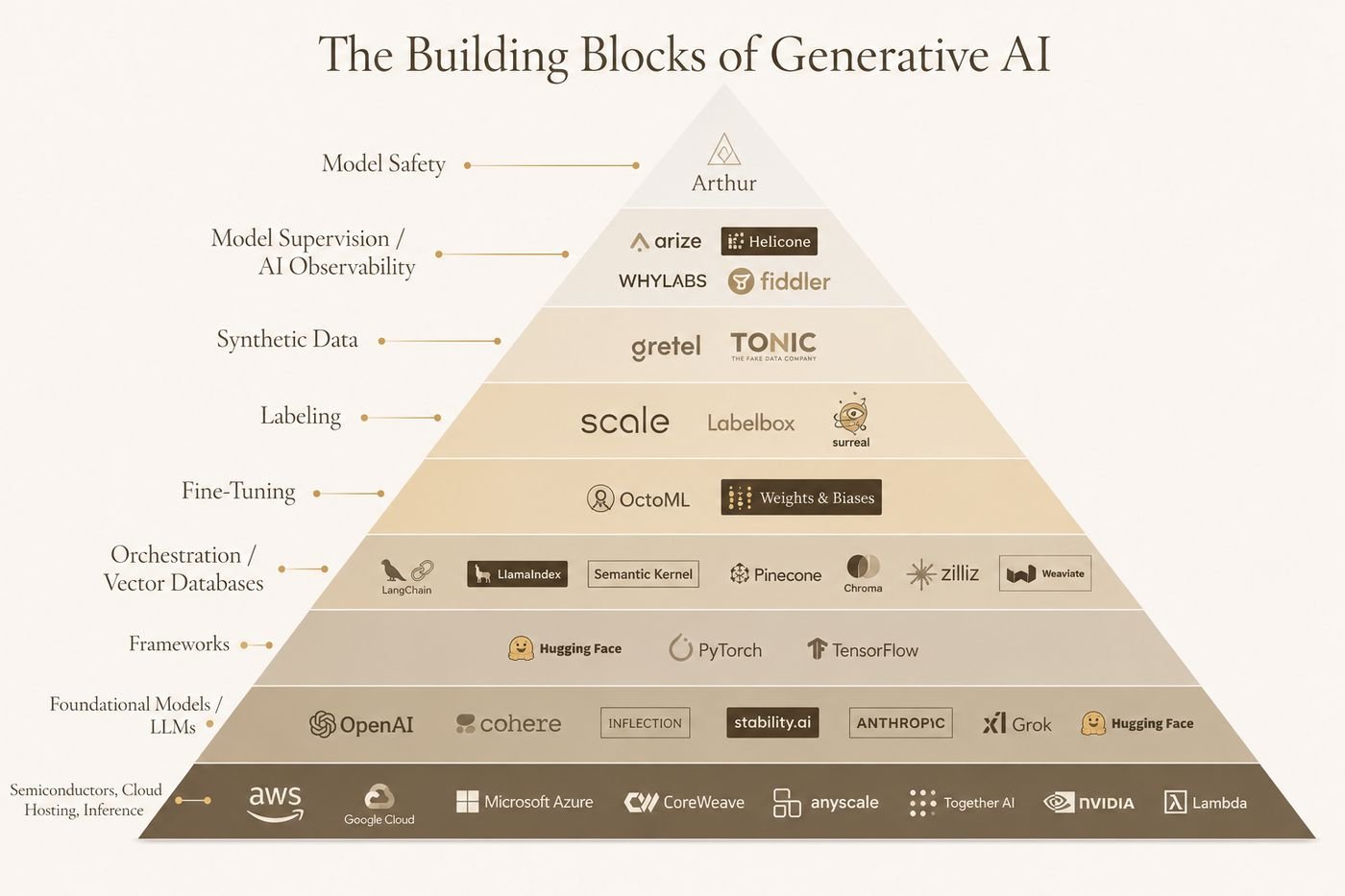
The problem is that one useful layer of AI has been allowed to become AI itself. A handful of companies had the capital, infrastructure, and market power to make their answer the default answer, and the rest of the system has been forced to reorganize around it.
Somewhere along the way, we stopped talking about artificial intelligence and started talking almost exclusively about frontier language models and hyperscale data centers, as though they were AI itself. LLMs have now captured the narrative and the capital structure, and they are not the only answer. As AI researcher Melanie Mitchell argues, today’s LLMs show highly uneven capabilities and significant limitations. Yet they have come to define the entire conversation while much of the broader field has faded into the background.
02The staggering scale of capital concentrated in one piece of AI
Five to eight trillion dollars: Goldman Sachs puts the cumulative build at about $7.6 trillion through 2031 and JPMorgan models $5.5 trillion through 2030, with an upside case near $7 trillion. Other estimates are lower, but the conclusion is the same: this is the largest capital commitment ever aimed at a single technological path.
What makes this different is who is spending the money and who is overseeing it. Apollo, the highways, and the Marshall Plan were public investments constrained by budgets and public accountability. This is private money deployed by a handful of companies, with governments offering little oversight and often active encouragement. Even the internet boom did not intertwine private capital and public support this tightly.
The more concerning element of this investment is the depletion of these companies’ cash reserves and their need for additional capital to close the gap. The largest technology companies are turning to debt and special financing vehicles that keep borrowing off to the side. Meta’s Hyperion data center is the template: a $27 billion deal, 80 percent owned by an outside investor, structured to keep the debt away from Meta’s balance sheet. The risk then moves into private credit, insurance companies, and pension funds.
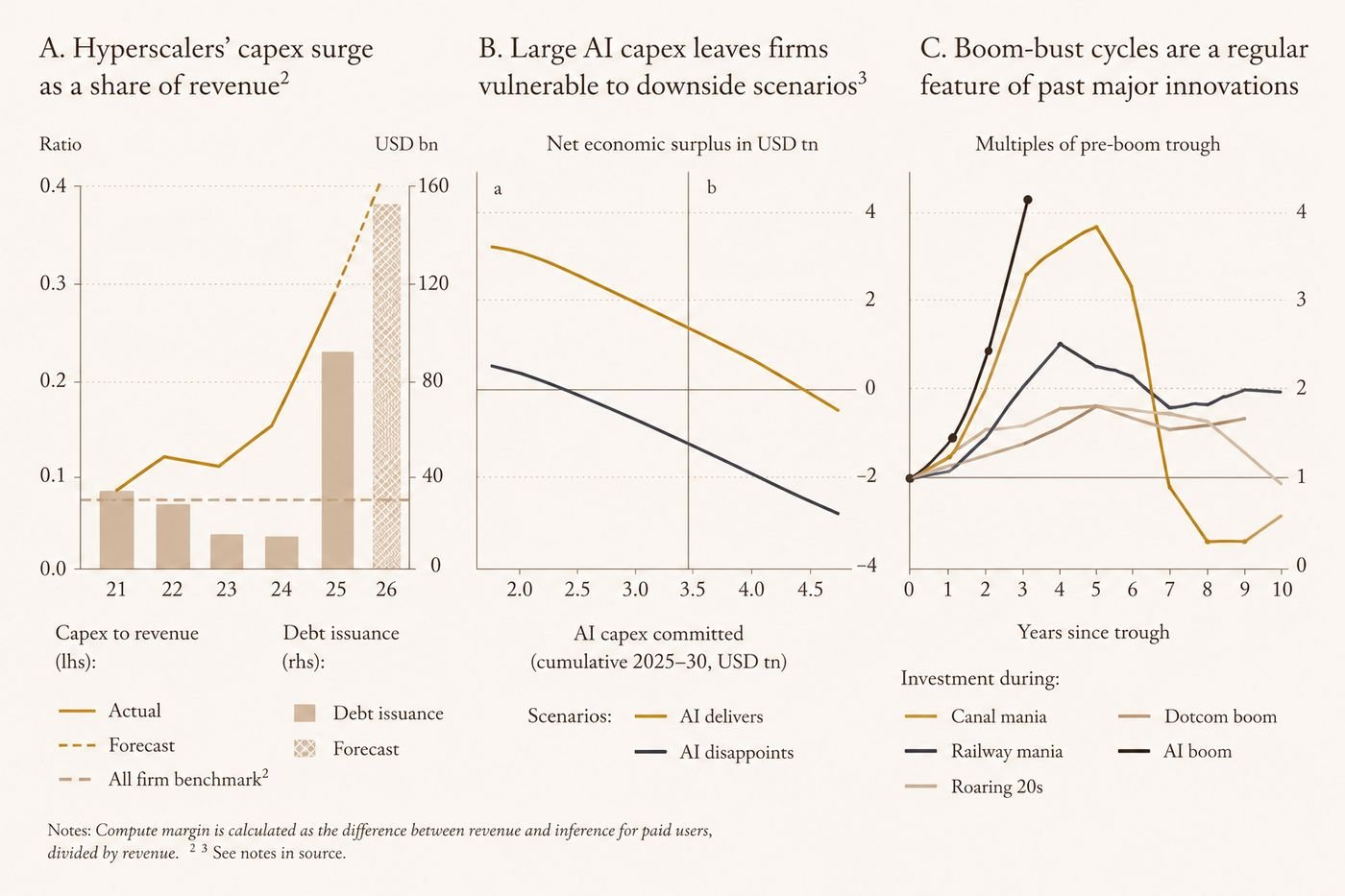
For decades, free cash flow and debt discipline were hallmarks of healthy companies. Hyperscaler capital spending once ran at roughly 10 to 15 percent of revenue; now it is moving toward 25 to 30 percent and is far higher for some companies. By 2026, they are reinvesting nearly all of their operating cash flow into this one bet, and it is still not enough. Debt markets are taking over. The BIS gave the shift a blunt title: “from cash flows to debt.”
The spending spree continues, with Amazon, Alphabet, Meta, and Oracle adding another $194 billion in bonds during 2026 through July 7, 79 percent more than in the comparable period a year earlier. Demand has fallen from roughly five times the amount offered to less than twice the amount offered, but that still means there is far more money available than they are trying to borrow. With so many other urgent places for capital to go, climate technology, biotechnology, agriculture, infrastructure, and countless others, it is remarkable that so much money continues to flow into the same narrow sector. That is a classic sign of herd behavior and a bubble.
Then comes depreciation. Nearly $520 billion in depreciation is expected to hit between 2026 and 2028. Depreciation is just accounting. The real issue is that the business isn’t generating enough cash to replace the hardware that’s wearing out. These GPUs may be depreciated over five or six years, but economically many are obsolete in closer to three. Eventually the accounting catches up with reality, and the liquidity problem begins. The chart below highlights this.
03The business model may not actually work
The concerns about liquidity, cash flow, and depreciation can all be overcome if the fundamental business model is sound. You can navigate through the rest of it. But the problem is that the business model itself may be an issue.
The frontier-model business is straightforward: companies sell tokens.
A token is a small unit a model reads or writes. Every prompt, response, and agentic step consumes tokens, which means GPUs, power, cooling, land, and continuous technology upgrades. Those costs are real.
In 2025, reported figures suggest OpenAI spent about $7.5 billion serving tokens and sold them for $13 billion, a gross margin of roughly 43 percent. Efficiency improvements have since pushed compute margins on paid use toward 70 percent.
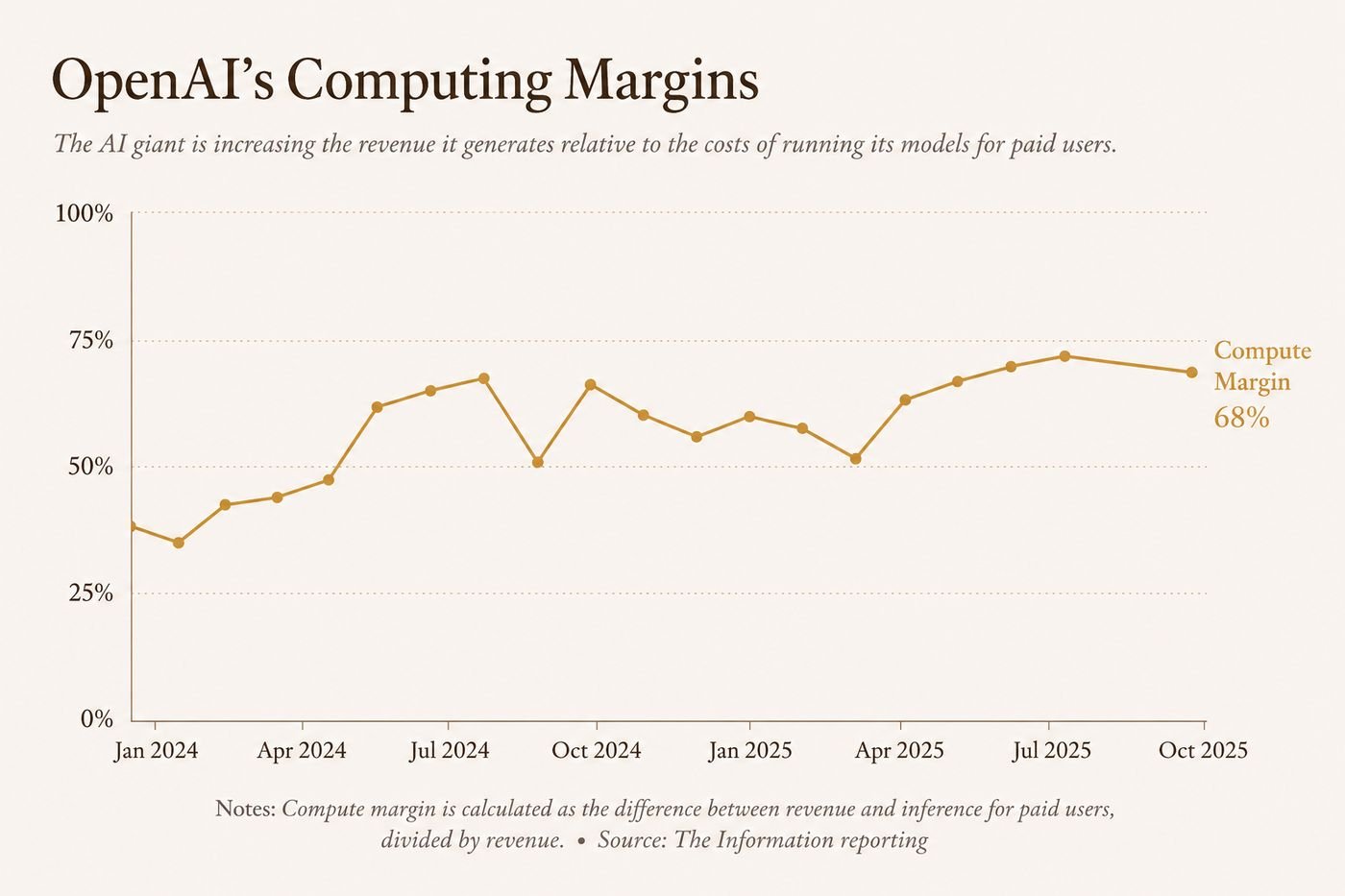
These are good and growing margins. Anthropic’s annualized revenue also doubled in a matter of months. On the surface, these companies appear to be scaling into the promise.
The problem is not the gross margin. It is the business model below the pricing line.
To win customers, models must deliver better results, and better results often consume far more compute. One analysis found that an aggressive reasoning model used roughly ten times as many tokens as a simpler model for the same coding task. The price per token may fall while the cost per useful task rises.
Industry gross margins are improving, but estimates still place them closer to 50–60 percent than the 70–90 percent common in mature software businesses.
The pricing strategy
Per-token pricing can work. Flat monthly pricing creates a different problem: heavy users can consume far more compute than they pay for. One measurement found a $200 subscription costing the provider as much as $14,000 in a month.
Pricing will evolve through usage limits, subscriptions, and token charges. But pricing alone cannot fix a business whose underlying costs rise with the sophistication and use of the product.
The real costs sit below the line
Gross margin captures only the cost of serving the customer. In 2025, OpenAI reportedly generated about $13 billion in revenue while spending roughly $7.5 billion to serve that usage, leaving about $5.5 billion in gross profit.
In 2025, OpenAI reportedly spent more than $19 billion below gross margin.
Two costs dominate the below-the-line spending.
First, training. More than $10 billion of that spending was raw compute used to build and rebuild models. It is a continuous cost of staying competitive, and it rises with every generation.
Second, hardware. Chips may remain physically usable for years, but they become economically obsolete much sooner. Goldman Sachs’ analysis shows that shortening their assumed life from five years to three changes the economics of the buildout by well over a trillion dollars. Microsoft’s CEO has acknowledged the danger of carrying five years of depreciation on a chip that is outdated in three.
Adding the two together, total spending was roughly $26 billion against $13 billion in revenue. That is not a pricing problem; it is a business-model problem.
At industry scale, the outside estimates land in the same place. JPMorgan says the sector needs about $650 billion in annual revenue to earn a modest return. Bain says it may need $2 trillion by 2030 and still fall $800 billion short. The business model does not add up.
Microsoft now reports that its AI business has surpassed a $37 billion annual revenue run rate, up 123 percent in a year. While that is meaningful progress, it also shows there is a long way to go. Microsoft’s entire disclosed AI run rate is less than 2 percent of the $2 trillion in annual industry revenue Bain estimates will be required by 2030. Microsoft does not separately disclose the capital, depreciation, training expense, or operating cost behind it. The evidence shows that AI monetization is becoming real. It does not yet show that the economics are approaching the scale required to support the buildout.
This does not stop with the larger companies. Even in the startup space, where you would expect the next generation of companies to form, we are seeing problems.
Venture funding peaked near $800 billion in 2021, fell after the pandemic, and then returned in a radically concentrated form. AI rose from roughly a third of venture dollars in 2022 to more than half in 2025 and about 80 percent by early 2026. Capital meant to fund the next generation of everything is being pulled into one sector.
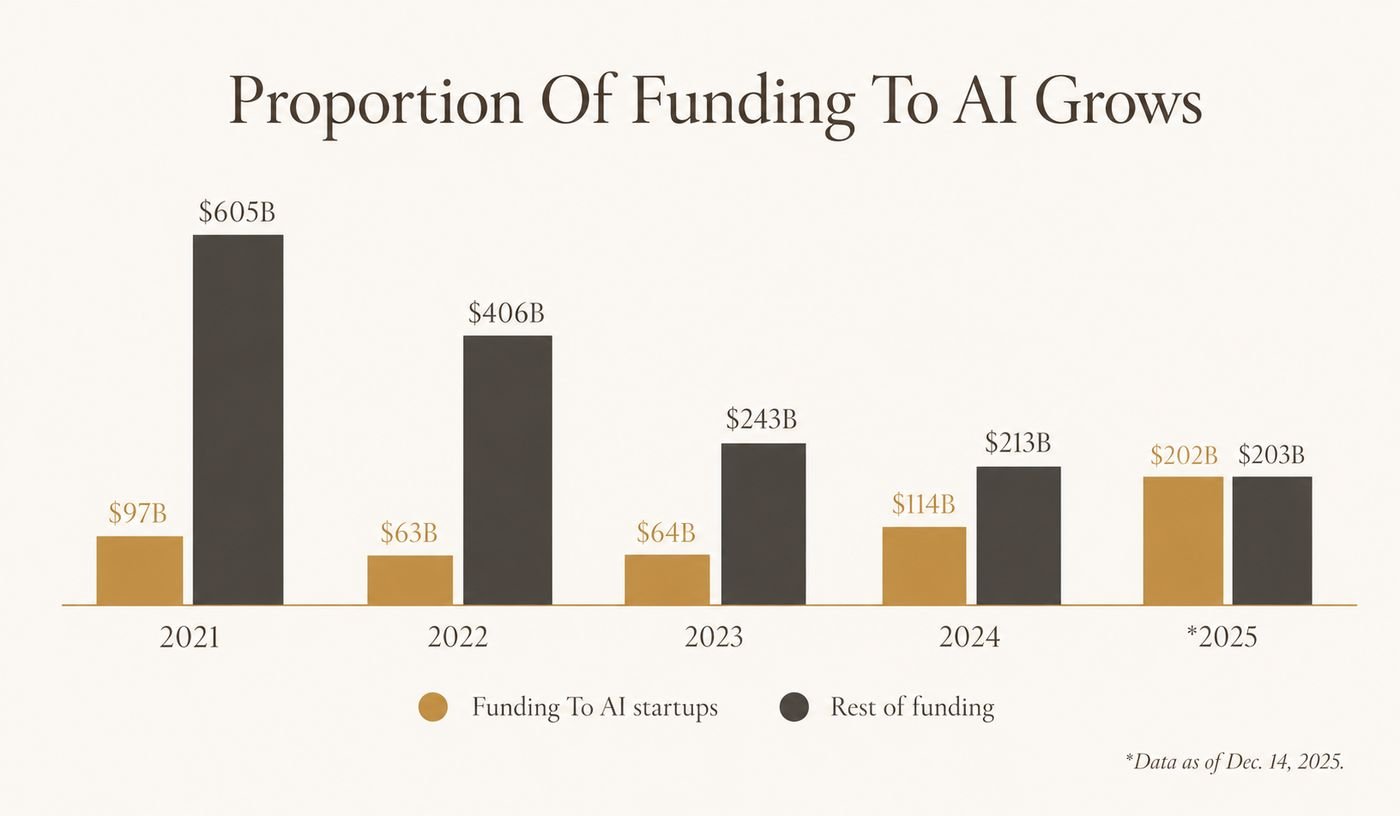
The largest AI companies have drawn money from sovereign wealth funds, corporations, private equity, and private credit. Five companies alone took $84 billion in 2025, about a fifth of global venture funding.
Meanwhile, accounting, biotech, climate, education, fintech, industrial systems, and thousands of other applications fight over the remainder. The same concentration happening inside AI is starving innovation outside it.
Venture capital accepts that most bets fail because a few winners become enormous. For three decades, enterprise software was a sector that supplied those winners.
The model worked because revenue was contracted and recurring while the cost of adding another customer approached zero. That is why successful software companies could reach 70–90 percent gross margins. It is also how VCs have tended to view AI startups.
AI companies do not scale that way. Every user consumes compute. Neocloud customers pay for hardware turnover, power, and every token; companies that build their own models absorb the training bill. Either way, scale brings costs with it. Surveys show compute consuming about 23 percent of revenue at scaled AI companies, with 84 percent reporting margin erosion.
Yet venture investors priced these companies as if they were software businesses whose margins expand with scale. If that assumption fails, the fallout does not stay inside venture portfolios.
There is a counterargument. Infrastructure booms often destroy investor capital while leaving lasting social value. Railroads, telecommunications, and the early internet were overbuilt; companies failed, and assets were written down, but the infrastructure later enabled industries that the original builders could not foresee.
AI may follow the same path. The buildout could be excessive, poorly timed, and badly financed while still leaving behind a valuable intelligence infrastructure.
The question is not whether AI creates value. It is whether today’s investors capture enough of that value, soon enough, to service the capital committed, and whether society can absorb the financial and labor disruption during the gap.
So, if you pause and look, a handful of AI companies have driven the entire narrative, capital cycle, and investment trajectory around a sliver of the AI stack. This is a system completely out of balance. No healthy economic structure should allow a few companies to dictate the direction of global technological advancement and investment. Moreover, this is being done with no oversight.
04It gets worse when you look at the economic indicators
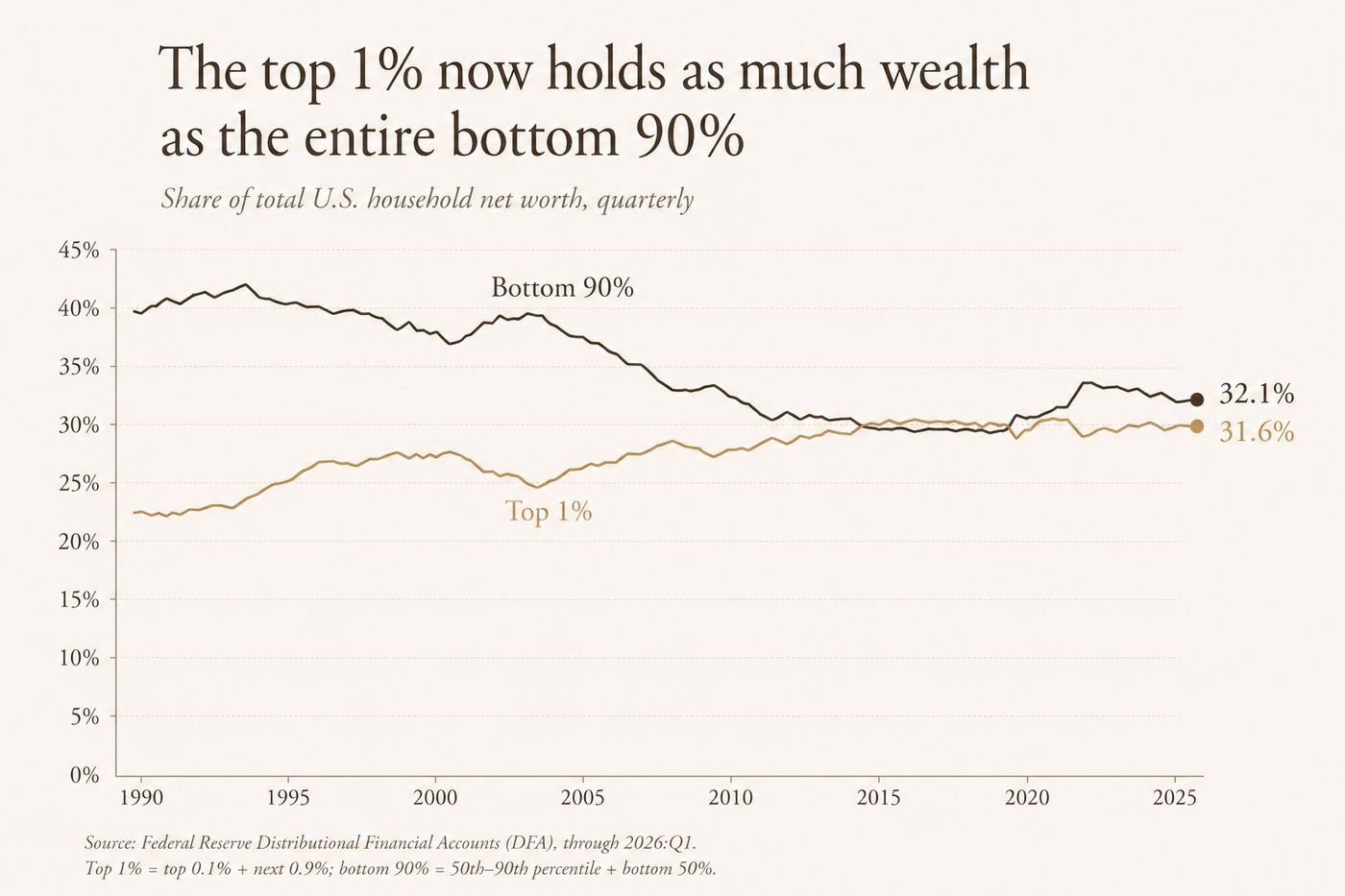
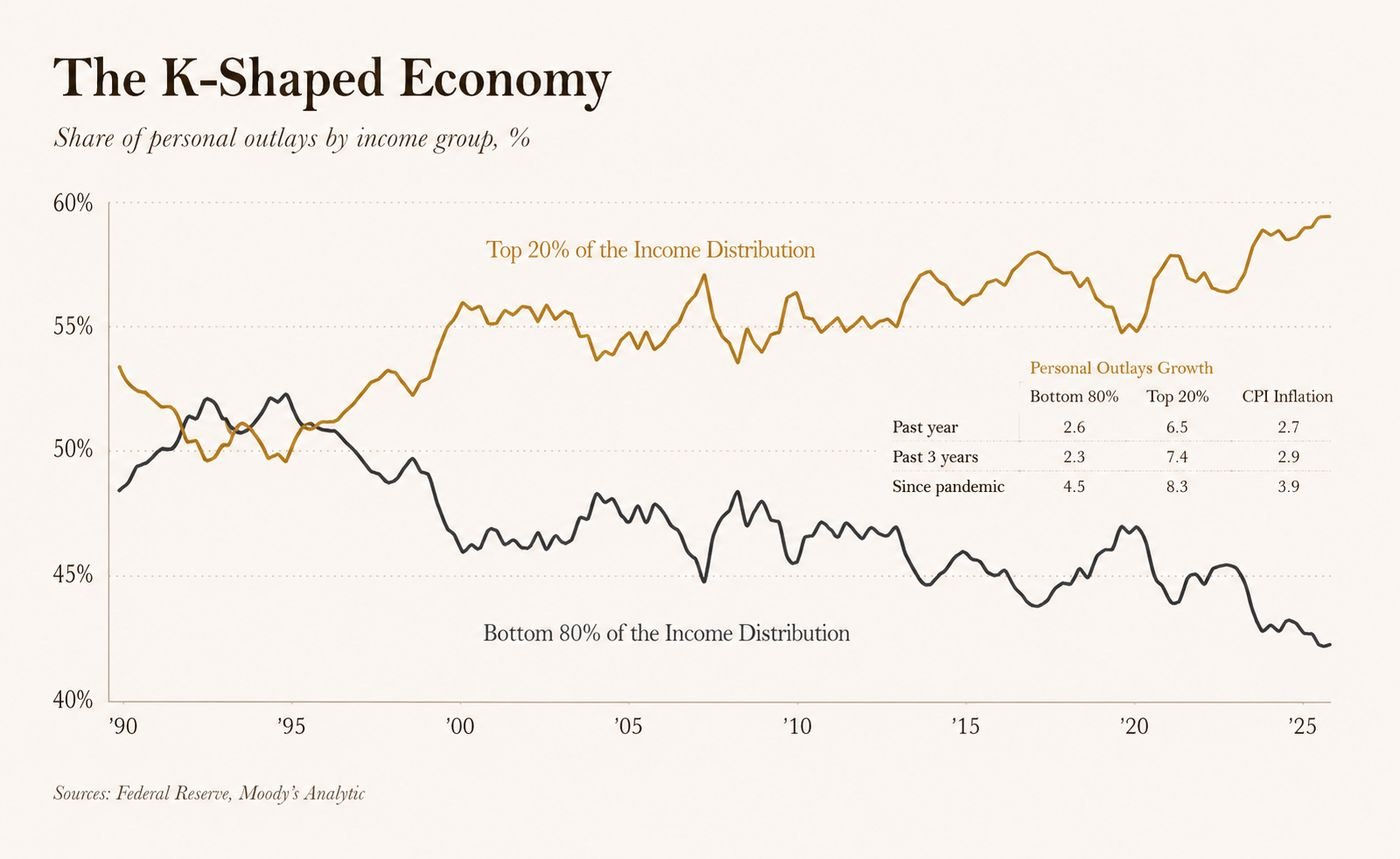
AI capital spending reportedly drove about 74 percent of U.S. GDP growth in the first quarter of 2026. That is often cited as proof of AI’s importance. It may instead show how narrow the economy has become. Data-center construction and the spending of the wealthiest households are holding up the headline numbers while much of the population falls behind. The top 20 percent now account for close to 60 percent of consumer spending; the top 1 percent holds as much wealth as the bottom 90 percent. The same gap between a healthy-looking number and an unhealthy underlying system appears here at national scale.
05And then they killed their own customer
A couple of years ago I attended an AI panel where everyone was praising the technology. Then a young woman asked: “What are you going to do about the millions of jobs eliminated by the efficiency you just described?” The panel could not pivot away from the question fast enough.
During the internet boom, the answer was that new jobs and economies would emerge, and many did. Technology eliminated some work but opened other doors because it remained human-centered. AI proponents are recycling that talking point again. It is easy to do. But it is shallow in many respects.
The value prop for AI applications, robotics, automation, intelligent machines, even coding is often to remove the person from the loop. Less human capital and fixed costs.
So where do the humans go? And who buys the products if they no longer have jobs and income?
Every revenue forecast assumes a customer with money to spend, businesses buying software, and workers earning wages. Until we change our economic model from consumption economics to sustainable economics (we are nowhere close to doing that), consumer and corporate spending drives the economy.
Every payroll dollar eliminated is a dollar of demand pulled from the economy, expected to produce the hundreds of billions in revenue that make the buildout work. We are financing a trillion-dollar bet on future spending while destroying part of the ability to spend.
The effects are already appearing. A Stanford study using payroll records found employment among 22-to-25-year-olds in the most AI-exposed jobs down about 13 percent, while older workers in the same occupations held steady or grew.
There is another fragility. A salaried person keeps working through a slow month. An AI agent stops when the budget runs out. Companies may trade a stable human cost for a metered one, then discover that work stops when the meter does. If they have already dismantled the workforce, who is going to fill the gap when they need people back?
06The contagion: telecom and 2008 all over again?
The financing of the build out is where a bad business can become a systemic danger.
Much of the infrastructure does not sit on the balance sheets of the companies driving it. One major data-center campus is 80 percent owned by an outside investment firm, with debt sold into pension and insurance portfolios. The structure depends on a handful of large customers paying their bills. One AI lab has reportedly signed more than $1.4 trillion in long-term compute commitments against a fraction of that in secured funding. If a major customer stumbles, the losses do not stay in one place.
Suppliers from batteries and fiber to power equipment, processors, compressors, and cables are building capacity around the same demand forecast. A slowdown reaches companies without the balance sheets to absorb it, leading to layoffs, failures, and another loss of purchasing power.
The financing is also circular. Nvidia invests in OpenAI; OpenAI buys Nvidia chips and signs a $300 billion cloud agreement with Oracle; Oracle buys more Nvidia equipment; AMD gives OpenAI the right to acquire a large stake while locking in a six-gigawatt commitment. The same small group appears as investor, customer, supplier, and counterparty.
The same dollars can appear as funding in one place, revenue in another, and backlog in a third. Analysts estimate more than $800 billion in this kind of circular financing. It works while money flows inward. The moment someone must sell instead of buy, the loop breaks.
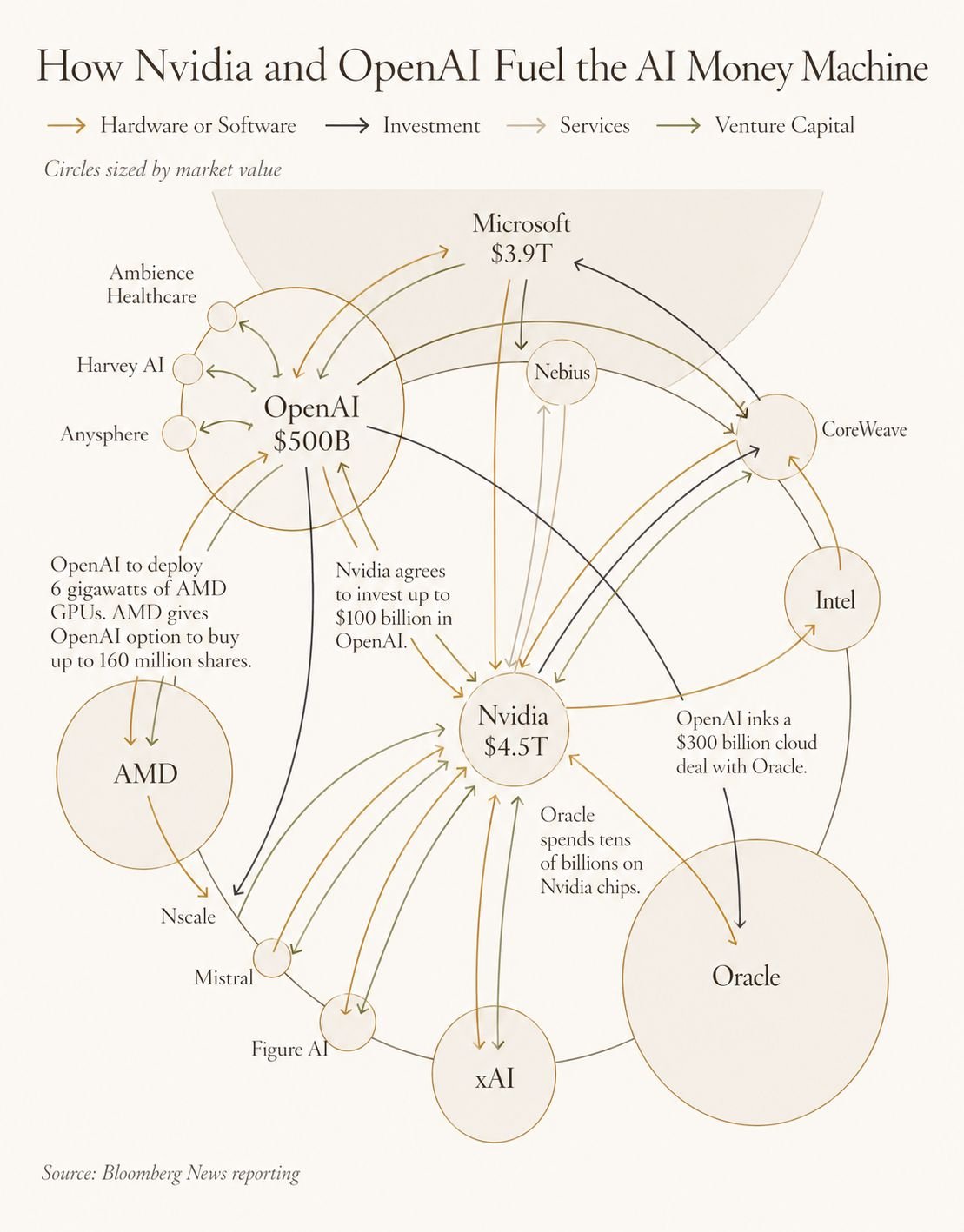
The risk then moves outward through financing vehicles into private credit, insurers, and pension funds. AI-related private credit rose from about $3 billion a decade ago to $40 billion last year. Much of the debt is rated safe, yet it is backed by rapidly depreciating chips and concentrated tenants whose own economics remain uncertain.
We have seen this in the past in 2008. It looks familiar, though it may not be identical. Concentrated capital risk is repackaged as diversified, rated safe, and distributed through the financial system. It also echoes telecom, where enormous amounts of fiber were built on debt before demand arrived. This buildout is occurring at several times the scale.
An analyst at Groundbreaker makes the argument bluntly: strip away the technology story, and much of this is a real estate and structured-finance deal dressed as tech.
The BIS, Treasury analysts, and bank economists remain measured in describing the danger. But the contagion could be worse than their language suggests because the plumbing is complex, concentrated, and largely hidden. At a minimum, it is prudent to understand it before the stress arrives.
07The geopolitics makes it more complex still
Frontier AI did not merely create a business. It set off an arms race.
The United States leads in compute, models, and GPUs. China, constrained by chip controls, built lighter and more efficient models. India is developing a sovereign stack; the Gulf states are providing capital; Europe is trying to catch up. No serious country wants to hand the brain of its economy to a rival, so local models and local compute are spreading everywhere.
The motivations differ. China seeks control as well as growth. China and Japan face aging populations and strong pressure to automate. Taiwan and Korea hold chip manufacturing as both a shield and leverage. Ukraine turned drone warfare into a reality of the modern battlefield. Each actor brings a different resource and protects a different interest.
No country believes it can step away. Losing the race is treated not as missing an investment, but as becoming a second-tier state. That makes restraint nearly impossible, even if the economics are deteriorating.
At the same time, technology companies have grown as large as national economies. The last time we saw something like this was the British East India Company. But even though they ran a country even faced they still faced parliamentary constraints. Technological change has outrun the ability of legislators to govern it, while the capital behind technology increasingly shapes politics itself. A backlash is coming.
Jon Stewart on The Daily Show did an interesting segment on the age of the US House and Senate. We have had six deaths in the House and Senate in the last quarter alone, and the third oldest Congress with an average age of nearly 64.
How can a body of legislators, most of whom were born and in their prime before the advent of the internet, remotely keep up with AI? The answer is that they don’t. Hence, we have a system that is badly out of whack. Technology is running roughshod over governments that barely understand it, while finance keeps feeding the boom because the money and momentum are too large to resist. A handful of companies are making choices that reach far beyond products or shareholders, and there is almost no functioning counterweight.
Almost no major power is asking what a healthy society on the other side looks like. Earlier technological leaps created more workers, customers, and opportunities. This one threatens the human work on which the system depends. Thinkers behind Earth4All and the Club of Rome have spent decades describing a wellbeing economy, but the countries controlling this technology are not governing toward one. The thinking exists where the power does not.
This is where the story turns. The bubble resembles earlier financial downturns, but it sits inside a geopolitical structure they did not have. Chips, energy, capital, models, and national security are wired into the same buildout. No one controls the whole chain; everyone holds one link and needs the others.
It is difficult to predict what the fallout would look like. The 2008 crisis began in the United States and created global financial reverberations, but it was not deeply intertwined with national security. If this bubble bursts, the outcomes will be more complex. More importantly, navigating them will require adults in the room around the world, and at the moment, we have a shortage of statesmen and stateswomen able to guide us through it.
08The last bill: a hollowed-out workforce
There is one more cost, and it lands after the financial dust settles.
In the rush to cut payroll, companies are gutting the bottom of the talent pipeline, the entry-level jobs where people learn to become the experienced workers every organization eventually needs. Young workers are displaced, computer-science enrollment is beginning to fall, and the training ground is disappearing before anyone knows which skills will matter.
If the economics of AI disappoint and companies need people again, many of those people will not be available or trained. Experience cannot be rebuilt quickly. The lost years become a social cost that outlasts the bubble and falls hardest on the generation trying to begin its working life.
09Societal pushback: the counterforce is finally forming
Communities are pushing back against the data centers arriving in their backyards. For years, developers walked into towns promising jobs, lower electricity costs, and economic growth. Local governments, often without the technical or financial expertise to test those claims, granted tax breaks, infrastructure support, and other incentives. Many communities are now discovering that there was minimal job creation while the demands on water, power, land, and public infrastructure are enormous.
An example is in The Dalles, Oregon, where Google now consumes about one-third of the city’s water. The city is seeking access to additional land in the Mount Hood National Forest to expand its reservoir system as Google’s water demand grows. In Fayetteville, Georgia, residents discovered that a QTS data-center campus had used nearly 30 million gallons of unmetered water after neighbors began reporting low water pressure. In New Brunswick, New Jersey, residents organized quickly enough that the city council removed data centers from a redevelopment plan and restored the site to public use. These are not isolated environmental disputes. They are communities learning what the infrastructure actually requires and deciding that the promised bargain is not good enough.
The industry has technical alternatives. Closed-loop liquid cooling, reclaimed-water systems, and dry cooling can sharply reduce direct water consumption, although some options increase electricity demand or cost. Yet those systems are not adopted uniformly because the cheapest local design often remains the default until communities, utilities, or regulators force a different answer. The companies are now trying to market their way out of the backlash. I recently watched an advertisement in the middle of an Amazon Prime program claiming that data centers lower energy costs and can support the grid. The argument felt like the plastics industry explaining that microplastics are manageable while the contamination continues to spread.
The power problem also extends beyond the rack. AI training produces rapid, synchronized swings in electricity demand. Those fluctuations begin as voltage-sag and power-quality problems inside the data center, but at sufficient scale they become a grid-planning and grid-stability problem. Spencer Gore and his colleagues describe how AI workloads create power volatility that utilities and conventional generation were not designed to absorb. The issue is therefore not simply whether enough electricity can be generated. It is whether the wider system can respond quickly and reliably to enormous, volatile loads without shifting the cost and risk onto everyone else.
New York has now gone further than any other state. In July 2026, Governor Kathy Hochul ordered a one-year statewide moratorium on new hyperscale data centers while the state develops rules to protect ratepayers, natural resources, the energy grid, and local communities
This is an example of where we, the people, still have a say. The counterforce is emerging from residents, utilities, and state governments because national leaders have largely failed to govern the buildout before its consequences reached communities. The resistance will delay projects, increase costs, force redesigns, and cause some projects to be cancelled.
One of my mentors makes the crucial point that delay creates capital leakage. Land, engineering, utility deposits, interest, equipment reservations, site preparation, supplier expansion, and redesign costs continue to accumulate before a facility earns a dollar. Hardware and facility designs may become economically obsolete while projects wait for power, permits, or public approval. The companies will eventually pull back.
But by then, roughly $2 trillion of the projected $5–8 trillion may already be in the economic bloodstream: spent, under construction, financed, or contractually committed. We are no longer asking whether enough capital has entered the system to cause damage. We are asking how much damage occurs, where it lands, and how far it travels.
10Conclusion
The largest investment in human history has become the largest concentrated bet in human history, not on artificial intelligence as a whole, but on one implementation. That decision now reaches through economics, finance, the environment, labor, power, and geopolitics.
The first real counterforce is now appearing where the physical system meets society. Communities are refusing projects, states are pausing permits, and utilities are being forced to confront water, power-quality, and ratepayer consequences that were previously treated as someone else’s problem. This resistance is necessary. It is also arriving after an enormous amount of capital has already entered the system.
Delays will slow the buildout, but they will not return the money already consumed by land, construction, equipment, financing, and supplier expansion. With roughly $2 trillion already spent or economically committed, the downside is no longer a theoretical future attached to the full $5–8 trillion forecast. Enough capital is already embedded in companies, credit markets, utilities, suppliers, and communities to produce serious systemic damage if the economics fail.
The most troubling part of this entire process is that a handful of companies have driven this boom. The consolidation of capital, access, infrastructure, and momentum has created this giant bubble. It is hard to pinpoint another moment in history where so few companies have shaped global financial markets and the direction of technological change to this degree.
It is also hard to think of a moment when technology and commerce have gone this directly at the heart of the human experience at this scale. AI can be a force for good. LLMs are useful. Data centers are useful. But they are not the five-to-eight-trillion-dollar only answer, and the mistake being made is that a handful of companies have made them exactly that.
We are not questioning whether AI will transform civilization or become a positive force. We are questioning whether concentrating unprecedented capital behind one path, before its economics, financing, governance, and consequences are understood, is responsible.
AI is needed and can have a profound impact on society and do real good. Automation can help, but only if we approach this with a balanced, systemic perspective rather than another technological bubble buildout like every tech bubble we have had.
As business leaders, we need to embrace the innovation, but with a highly systemic point of view. There is the low-hanging, easy fruit of cost savings with AI. But with a little systemic and strategic thinking and deliberation, we can be our own architects of it rather than being beholden to a captive supply chain. We are always derisking supply chains; then why not derisk AI? We have backups for our data and redundancies in our manufacturing systems. Why are we losing human capital to a machine with no backup? There is room to own this space.
If you are a political leader, understand the technology shaping the people and the economy. You were elected to govern.
11As citizens, we have the power
For instance, we can choose our elected officials by electing technologically literate people. Stop reelecting people who have been in Congress for three generations and are in their late 70s, 80s, and 90s. This is not about discriminating based on age, but fresh thinking is needed for a newer society. We need new, fresh modern thinking.
Technology is outrunning civic freedom.
History suggests transformative technologies survive bubbles. The costs do not stay with the people who created them. They spread through companies, workers, communities, financial systems, governments, and societies.
The system is completely out of balance, and a system out of balance will correct. The problem is that the correction will again affect the many who can least afford it.
There may be light at the end of this tunnel. It is emerging quietly at the edges, where AI is already solving real problems for real customers with far less capital. That is where the next paper begins.